
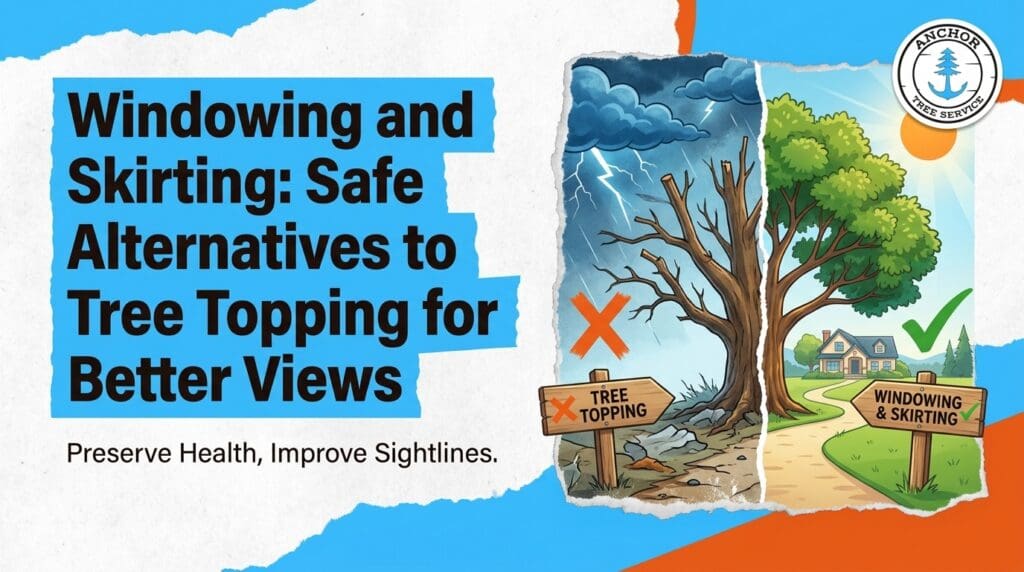
When homeowners want a better view, tree topping often seems like a quick fix—but it creates long-term problems. Windowing and Skirting: Safe Alternatives to Tree Topping for Better Views are pruning techniques that open sightlines while keeping the tree structurally sound and healthy.
Topping removes large branches indiscriminately, leaving stubs and a weakened crown. Windowing and skirting, by contrast, selectively remove only the branches that block your view, preserving the tree’s natural form and ability to recover.
Understanding the Risks of Tree Topping
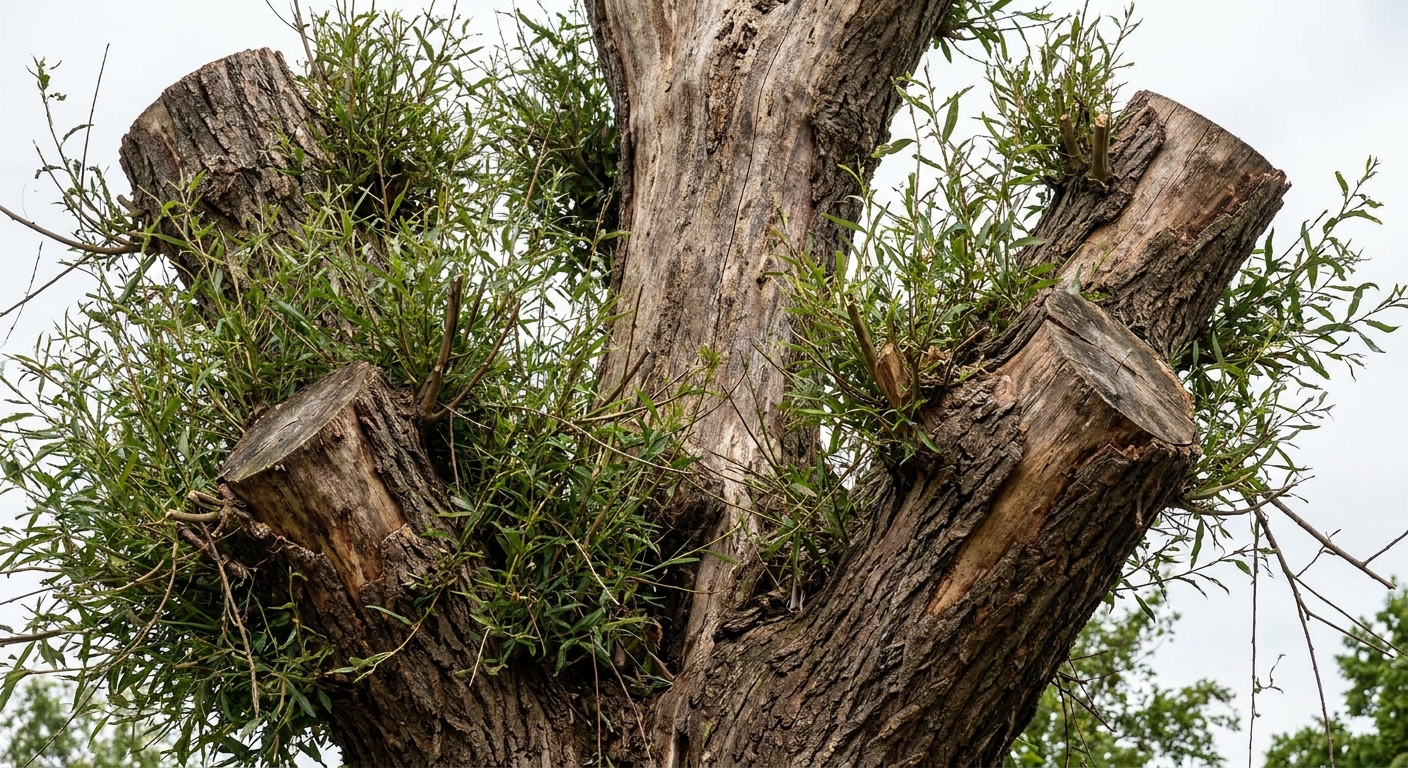
Tree topping is the practice of cutting back large branches to stubs or to lateral branches that are not large enough to assume the terminal role. This creates serious problems:
- Health decline: The large wounds expose the tree to decay organisms and pests, and the loss of foliage reduces the tree’s ability to produce food through photosynthesis.
- Weak regrowth: The tree responds with an explosion of weakly attached water sprouts that grow quickly but are prone to breaking.
- Structural hazards: The new branches are poorly attached and can fail in wind or ice, creating dangerous conditions.
- Unsightly appearance: Topped trees often look disfigured and take years to recover, if they ever do.
Because of these risks, professional arborists strongly discourage topping. Windowing and skirting offer a better way to manage views.
What is Windowing?
Selective Pruning for View Creation
Windowing is a specialized pruning method that creates specific openings, or windows, in the tree’s canopy to frame a desired view—such as a mountain range, water, or a sunset. Instead of removing large limbs indiscriminately, we identify the branches that are directly in the sightline and remove only those, making cuts back to the trunk or to a lateral branch that can take over.
This approach requires careful planning: we assess the view from key points on your property, mark the offending branches, and then prune with precision. The result is a view corridor that looks natural, as if the tree grew that way.
How Windowing Maintains Tree Structure
Because windowing removes only selected branches and always cuts back to a suitable lateral branch, the tree’s overall structure remains intact. The remaining branches continue to distribute wind loads evenly, and the tree can compartmentalize the smaller wounds quickly.
We never remove more than a small percentage of the live crown in a single windowing session, which keeps the tree vigorous and reduces stress.
What is Skirting?
Removing Lower Branches for Unobstructed Views
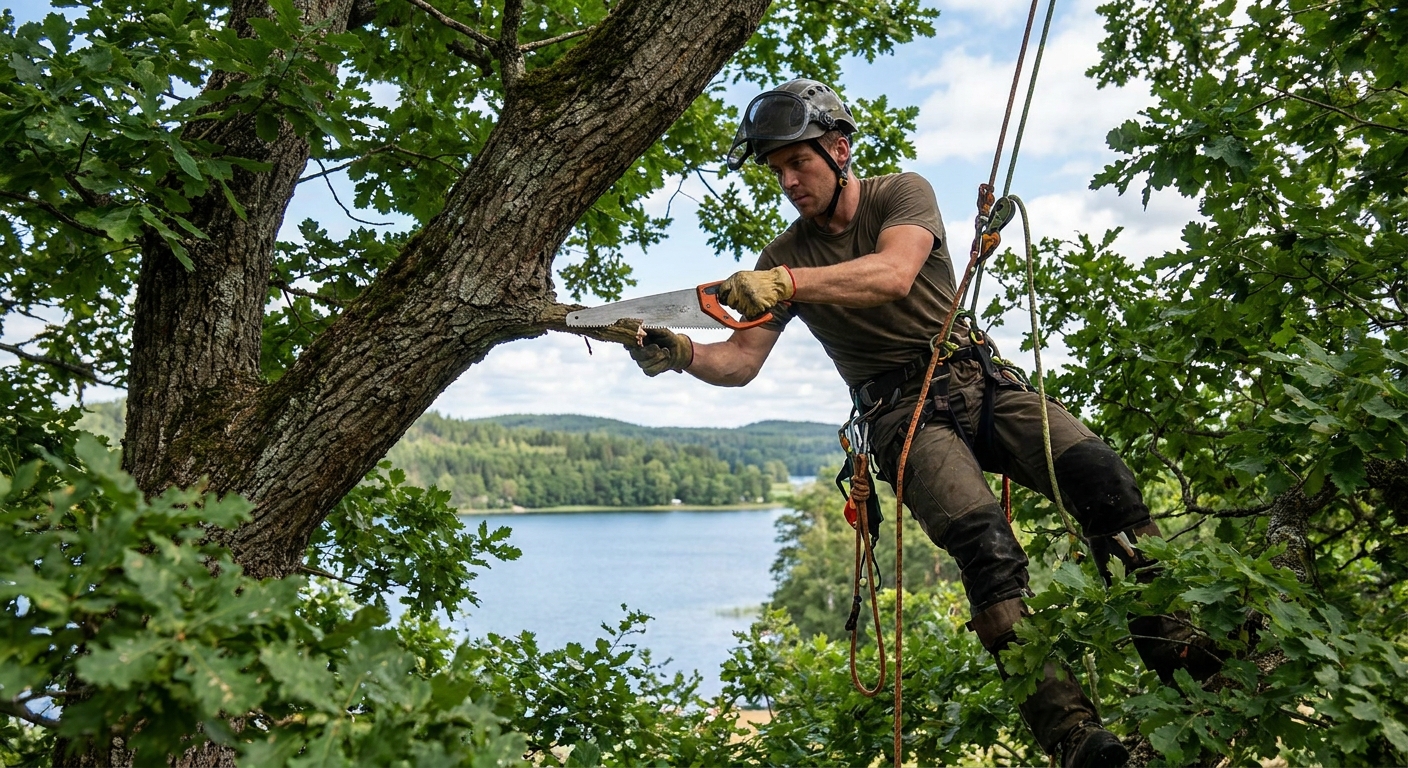
Skirting involves the selective removal of lower branches to raise the tree’s canopy—the lowest permanent limbs are cut back to the trunk or to a lateral branch at the desired height. This creates clear space beneath the tree, opening up views that were previously blocked by low-hanging foliage.
Skirting is especially useful for trees near driveways, walkways, or sightlines along a road, where low branches obstruct visibility.
Skirting for Safety and Aesthetics
Beyond improving views, skirting enhances safety by providing clearance for pedestrians, vehicles, and structures. It also gives the tree a cleaner, more formal appearance and can make a landscape feel more open and inviting.
Proper skirting preserves the tree’s upper crown, so the tree continues to provide shade and habitat while the lower area is opened up.
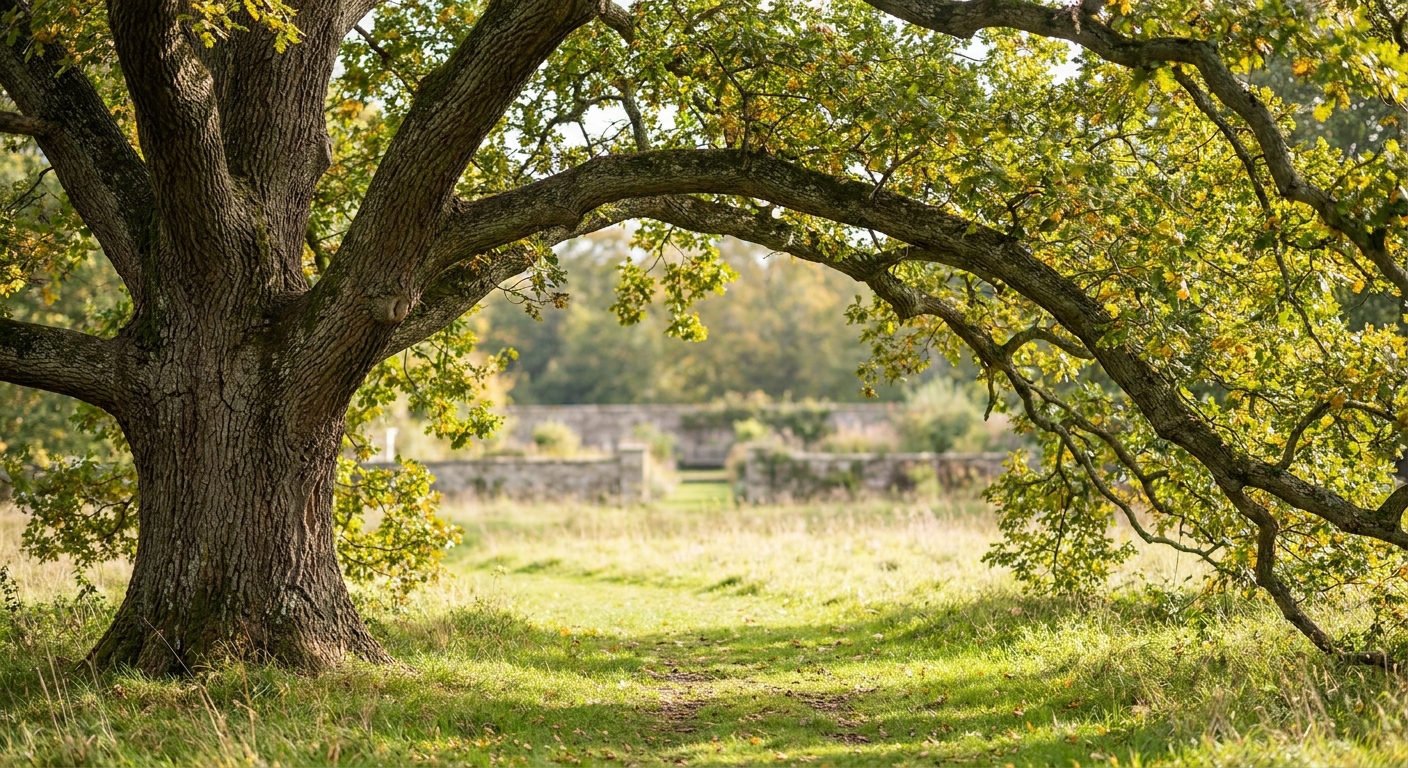
Benefits of Windowing and Skirting Over Topping
Preserving Tree Health and Longevity
Unlike topping, which removes large amounts of leaf area and creates large wounds, windowing and skirting are conservative: only the necessary branches are removed, and cuts are made at natural branch junctions where the tree can heal effectively. This reduces the risk of decay, insect infestation, and dieback, allowing the tree to live much longer.
The tree continues to produce enough energy through photosynthesis, so it remains vigorous and resilient.
Reducing Future Maintenance and Hazards
Topping triggers a cycle of weak regrowth that requires repeated pruning to manage, and those weakly attached sprouts are a constant hazard. Windowing and skirting do not create such regrowth; the remaining branches grow normally and maintain strong attachments. As a result, the tree requires less frequent intervention and is safer during storms.
By directing growth away from the view and maintaining structural integrity, these methods reduce the chance of future branch failure.
Enhancing Property Aesthetics and Views
A topped tree often looks butchered and can lower property value. Windowing and skirting, done correctly, are virtually invisible to the untrained eye: the tree keeps its natural shape, and the view is simply there. This enhances both the beauty of the tree and the enjoyment of your property.
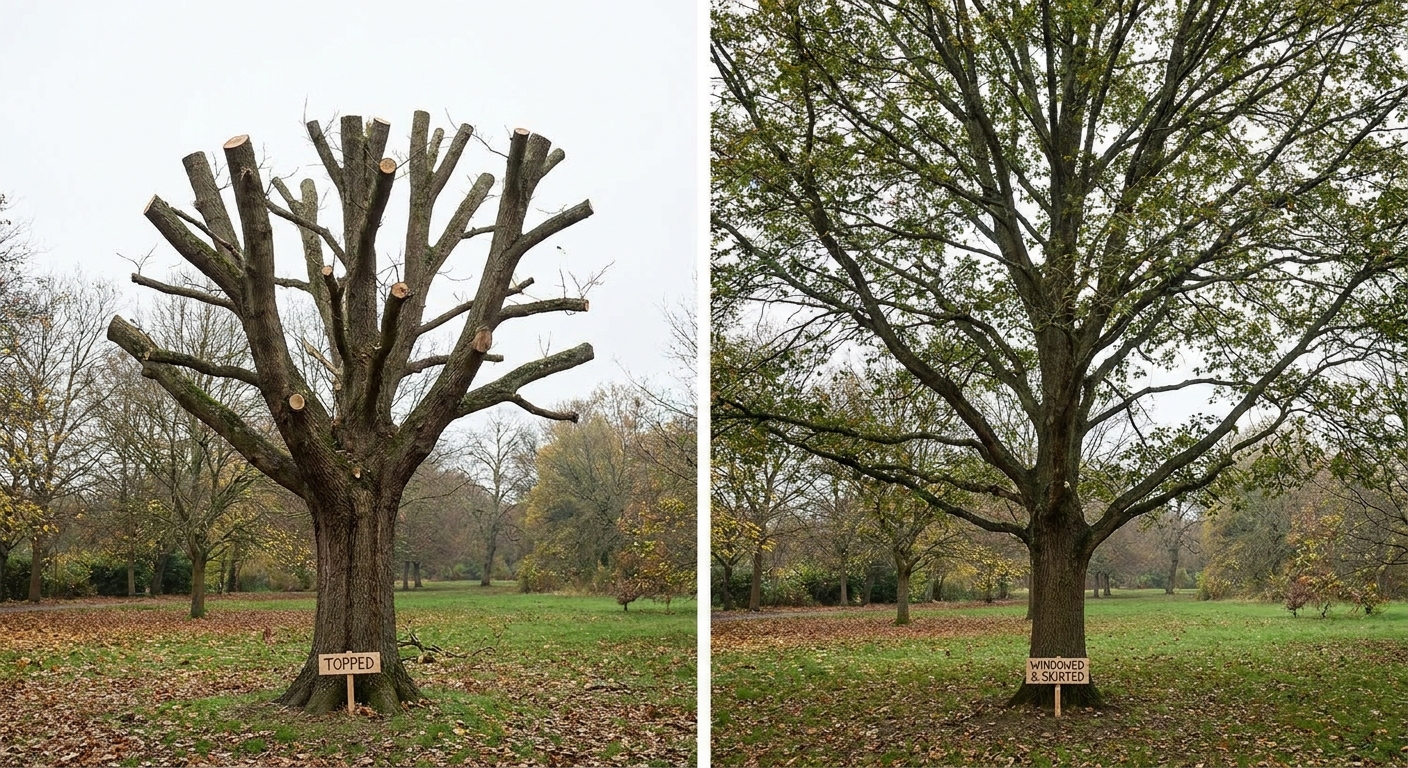
Choosing the Right Technique for Your Trees
Assessing Tree Species and Structure
Not every tree is a good candidate for windowing or skirting. Some species tolerate pruning well, while others are more sensitive. A professional arborist will evaluate the tree’s health, branch structure, and species characteristics before recommending a plan. For example, trees with included bark or existing decay may need a more conservative approach.
The size and location of the branches to be removed also matter: large lower limbs may require careful reduction cuts rather than complete removal to avoid creating massive wounds.
Considering View Objectives and Property Layout
We start by understanding what you want to see—and from where. Window frames a specific vista, while skirting opens up the ground-level view. In many cases, a combination of both techniques works best: skirting to raise the lower canopy, and windowing to create a framed opening above.
We also consider the tree’s role in the landscape, such as privacy, shade, or habitat, and we balance your view goals with the tree’s needs.
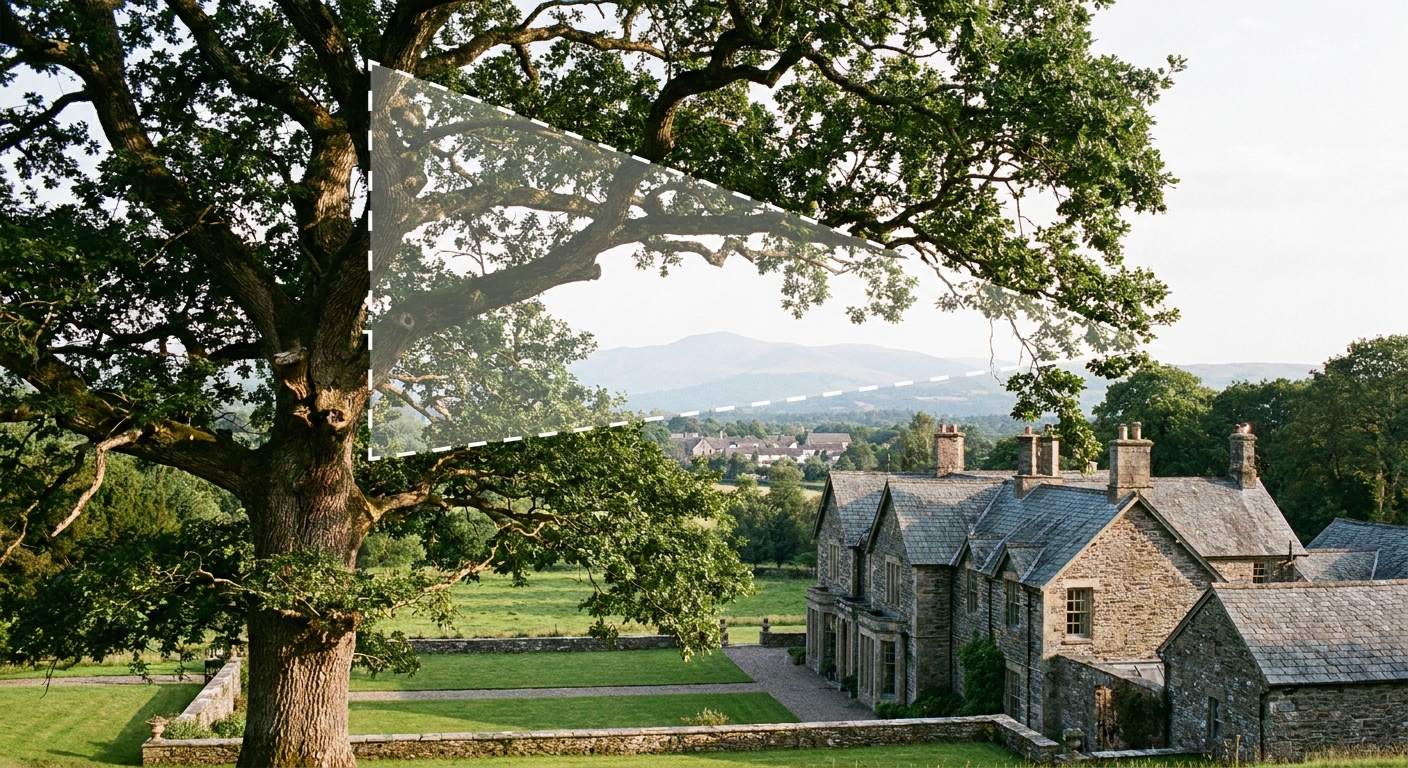
Why You Should Hire a Professional Arborist
Expertise in Tree Biology and Pruning Standards
Windowing and skirting require a deep understanding of tree biology and adherence to pruning standards (such as ANSI A300). Improper cuts can cause the same problems as topping—decay, weak regrowth, and structural failure. A certified arborist knows where to cut, how much to remove, and how the tree will respond.
Our team includes ISA Certified Arborists with Tree Risk Assessment Qualification, which means we approach every pruning cut with a deep understanding of tree structure and response. This training helps us identify weak branch attachments and decay before they become safety issues.
Proper Equipment and Safety Protocols
Working in a tree canopy with sharp tools is dangerous. Professionals use climbing gear, ropes, rigging, and sometimes aerial lifts to access branches safely without causing damage. They also carry insurance and follow strict safety protocols to protect people and property.
We do not recommend attempting windowing or skirting from a ladder or with hand tools; the risk of injury and improper cuts is high.
Conclusion
Windowing and skirting provide a safe, effective way to improve your views without sacrificing the health and beauty of your trees. By choosing selective pruning over topping, you preserve the tree’s structural integrity, reduce future hazards, and enjoy a landscape that looks intentional and natural.
If you’re ready to open up your view the right way, contact us to schedule a consultation with a certified arborist. We’ll assess your trees and design a pruning plan that meets your goals.
Areas We Serve
As you explore view-friendly pruning, our area hubs explain what we consider in each place—site conditions, seasons, and access—so you can gauge how the approach could fit your property and find the most relevant local information.
- Central Saanich Arborists & Tree Services
- Colwood Arborists & Tree Services
- Esquimalt Arborists & Tree Services
- Highlands Arborists & Tree Services
- Langford Arborists & Tree Services
- North Saanich Arborists & Tree Services
- Oak Bay Arborists & Tree Services
- Saanich Arborists & Tree Services
- Sidney Arborists & Tree Services
- Victoria Arborists & Tree Services